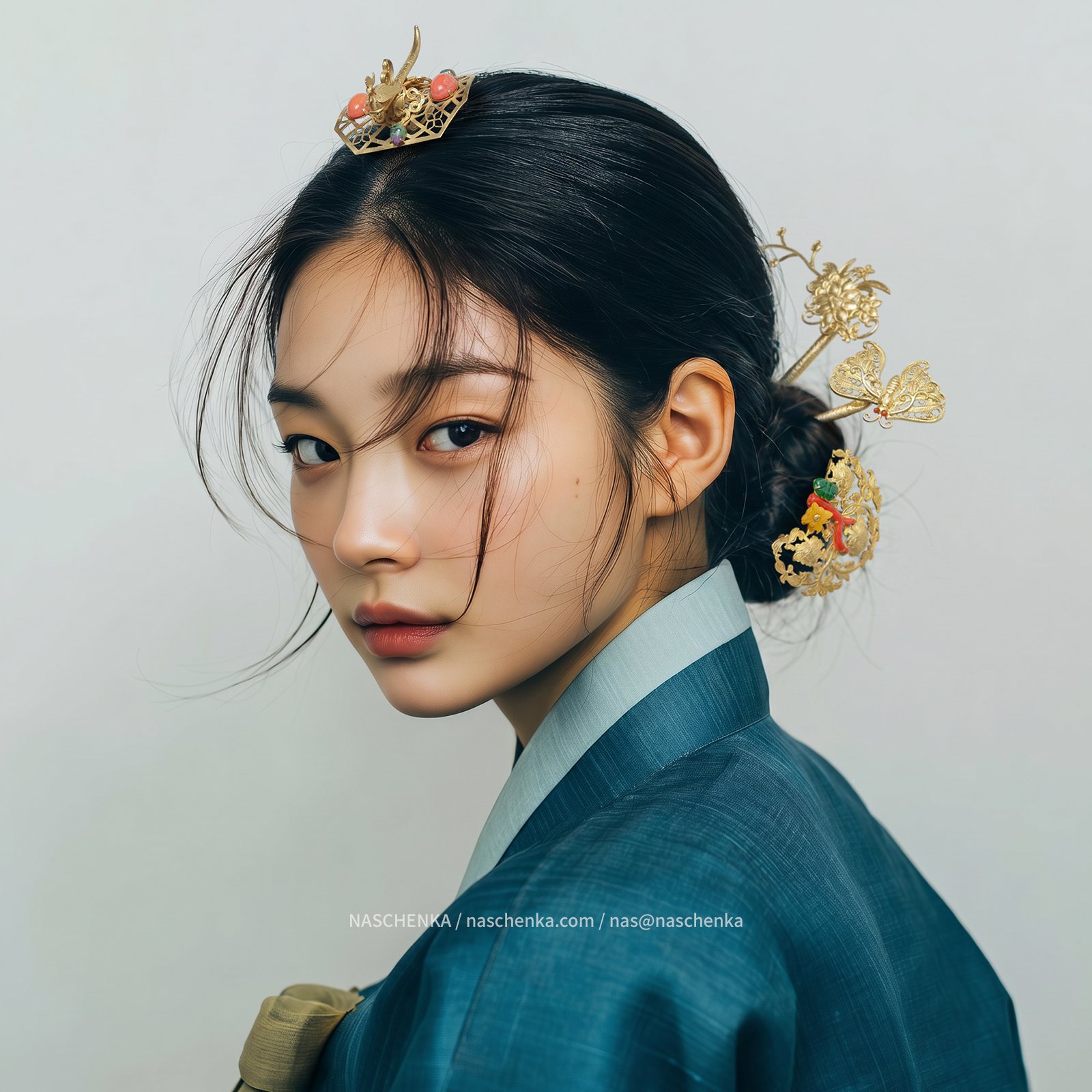
The rule is simple: the cheopji goes on the centre parting, at the front, head toward the forehead. Everything else follows from the hairstyle you wear it with.
The traditional way
- Part the hair cleanly down the centre.
- Fold a strip of purple or black cloth narrow enough to hold the cheopji, and set it on the parting.
- Set the cheopji on the parting, with its head toward the forehead.
- Comb the two hairpieces (dari) back along each side together with your own hair.
- Gather everything into a low chignon (jjok) and secure it with a binyeo.
- For ceremony, add dwikkoji to the chignon, and a jokduri or hwagwan on top.
At court the base was sewn firmly into the parted hair. The steps above follow the Dictionary of Korean Costume and the Academy of Korean Studies.
With a jokduri or hwagwan
This is the cheopji's second purpose. Set the cheopji first, then place the jokduri or hwagwan on the crown of the head behind it. The cheopji in front helps keep the crown from sliding forward through a long ceremony.
With a binyeo and dwikkoji
A cheopji, a binyeo and one or two dwikkoji make a complete formal hairstyle without a crown. Match the metals — gilt with gilt, silver with silver — and let the cheopji be the only ornament at the front.
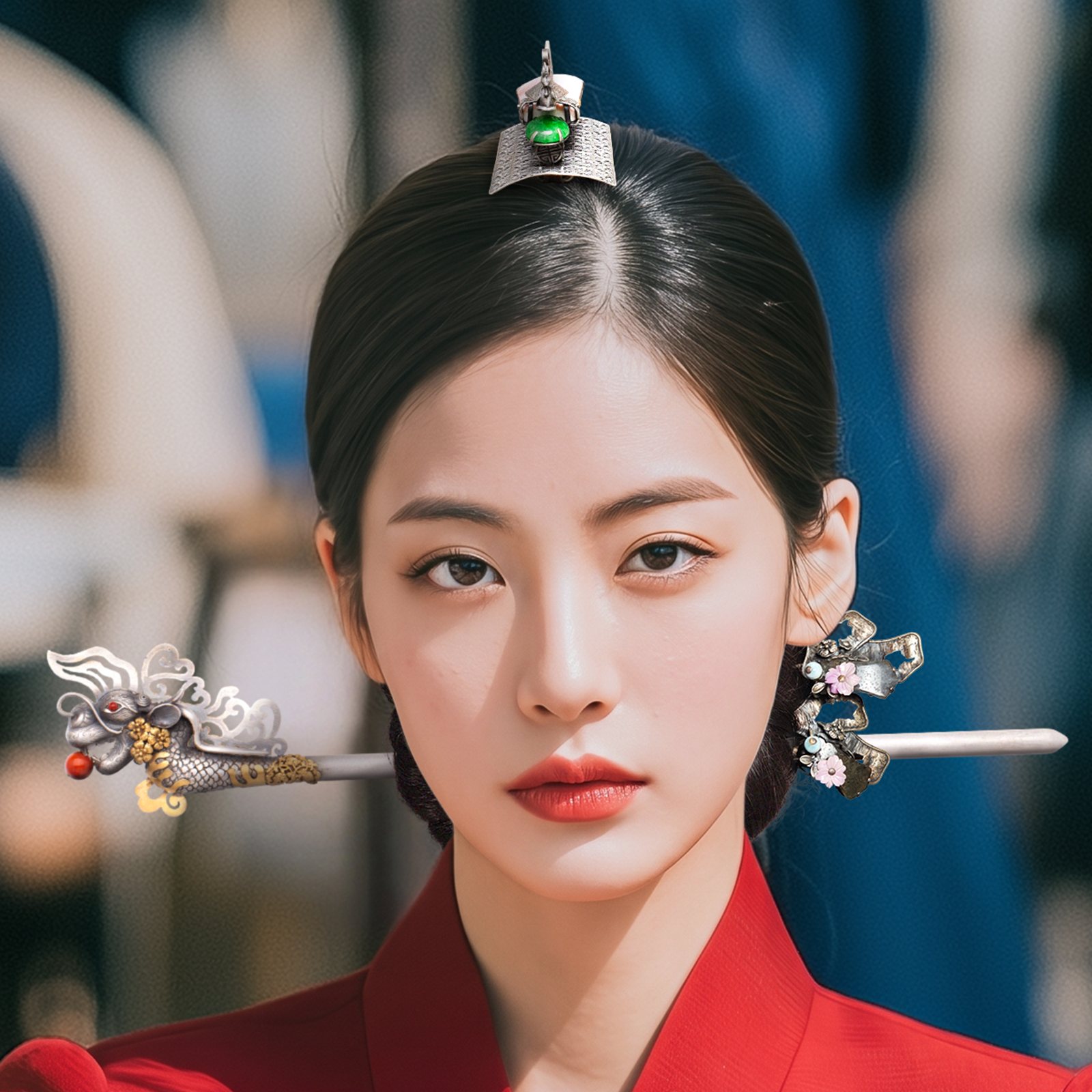
On modern hair
A one-piece modern cheopji can be worn on its own, on a centre parting with the hair down or in a low bun. Keep the parting sharp and the rest simple; the cheopji works because it is the only thing at the front.
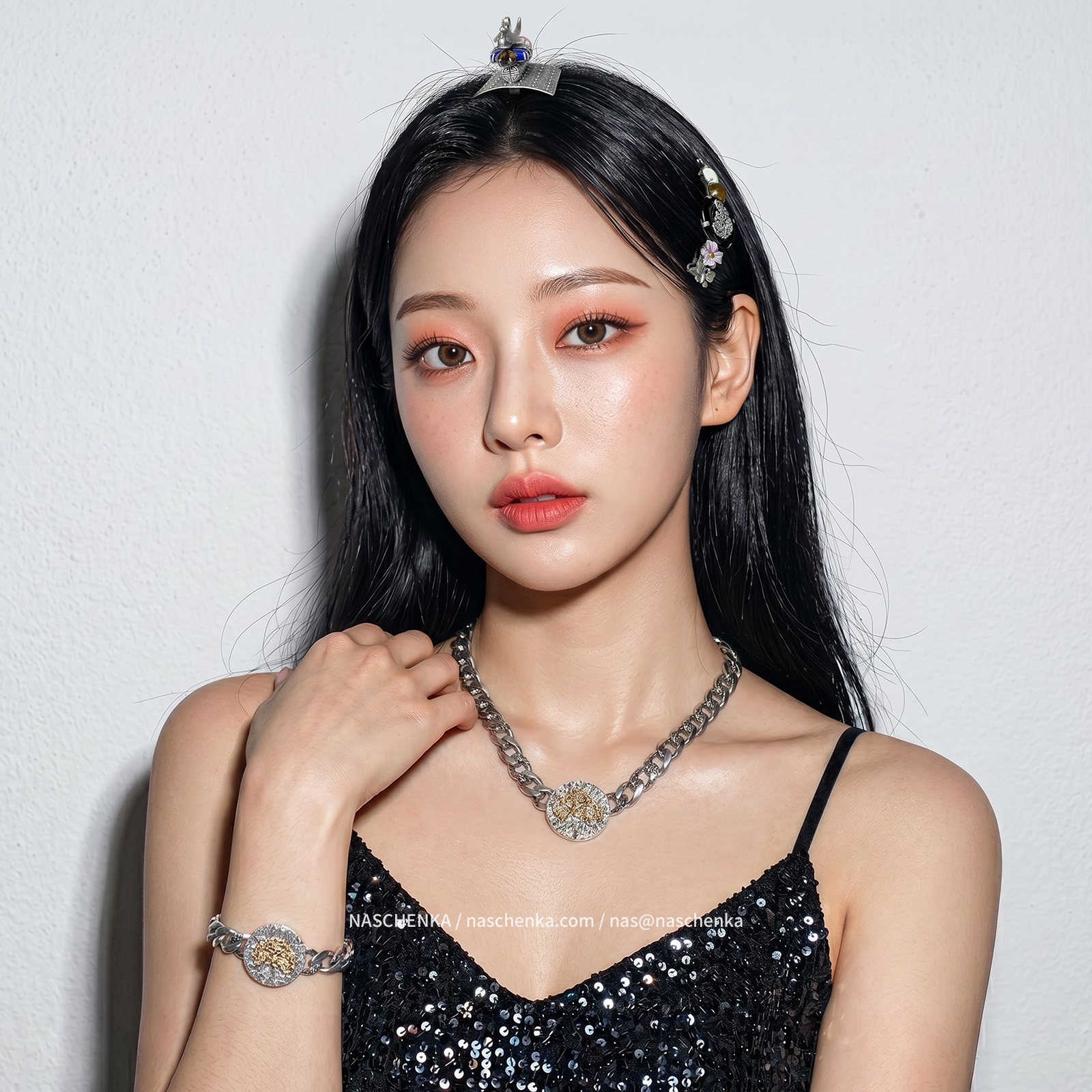
Common mistakes
- Placing it at the crown. The crown is where the jokduri goes. The cheopji belongs in front, on the parting.
- A soft parting. The cheopji sits on a line; a messy parting makes it tilt.
- Too many ornaments in front. Keep the front to the cheopji alone.
References
- Encyclopedia of Korean Culture (한국민족문화대백과사전), “첩지,” written by Son Gyeong-ja, Academy of Korean Studies. encykorea.aks.ac.kr
- National Research Foundation of Korea, Dictionary of Korean Costume (한국복식사전), “첩지,” via Academy of Korean Studies Digital Humanities. dh.aks.ac.kr
- Academy of Korean Studies Digital Humanities, “첩지 (貼只),” citing Kang Sun-je et al., Hanguk boksik sajeon (Minsogwon, 2015), p. 691. dh.aks.ac.kr
- National Palace Museum of Korea, “Phoenix cheopji of the Consort of Imperial Prince Yeong (영친왕비 봉첩지),” via Google Arts & Culture. artsandculture.google.com
- Sookmyung Women's University Museum, “Cheopji Hair Style” (replica), via Google Arts & Culture. artsandculture.google.com
- Yu Hui-gyeong, Hanguk boksiksa yeongu (한국복식사연구), Ewha Womans University Press, 1975.