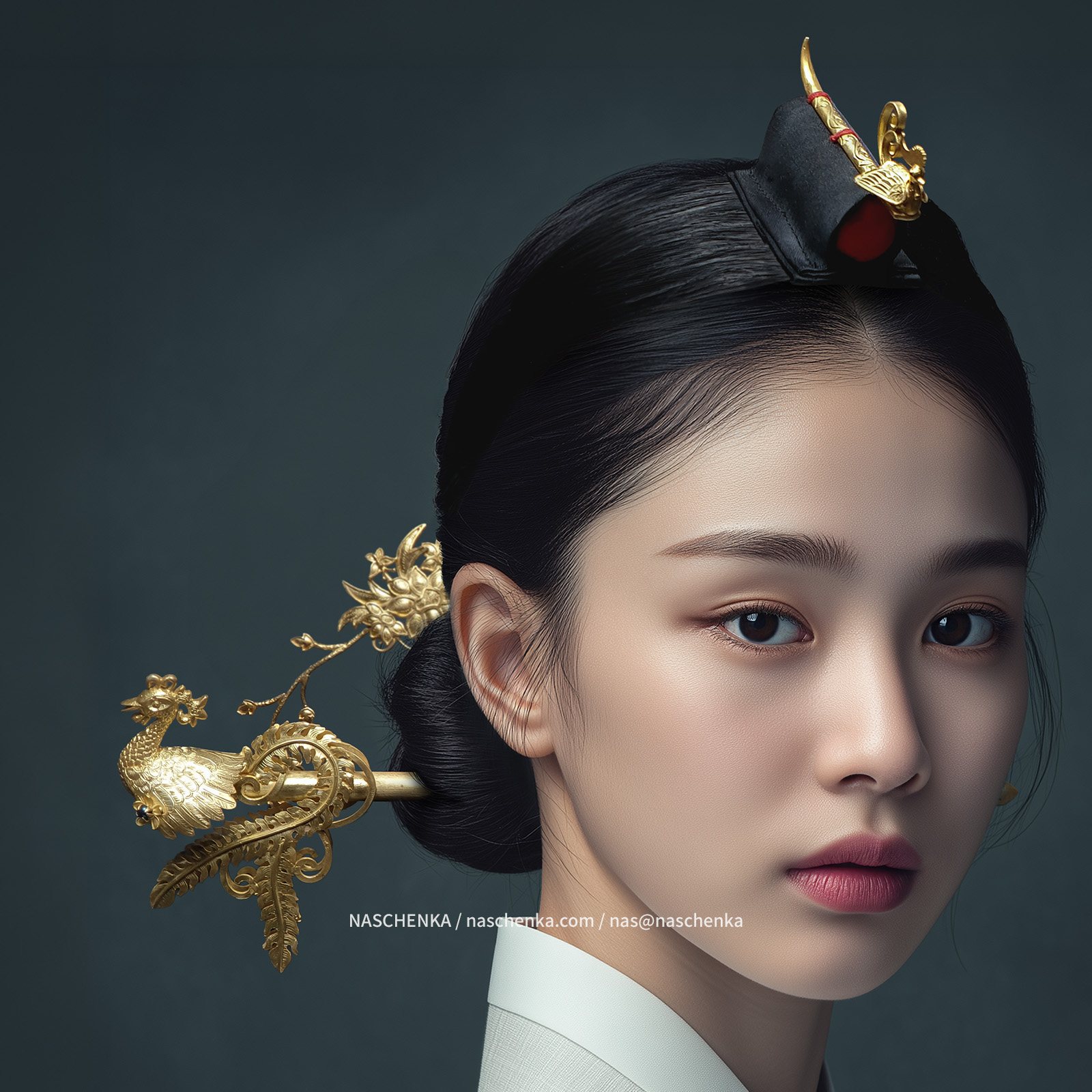
A historic cheopji is an assembly, not a single piece of metal. The Dictionary of Korean Costume describes it part by part. Read it once and you will recognise every one of them in a museum case or a drama.
1 · The body 동체
The metal body is seven to eight centimetres long. It lies horizontally on the head, and only the tail turns slenderly upward. The front carries the ornament — dragon, phoenix or frog — and only the front differs from one rank to another.
2 · The base 받침
The body cannot be worn alone. It is set on a padded base, wrapped in black cloth, which gives it something to sit on and something to be tied to.
3 · The red thread
The body is fixed to the centre of the base at three points — the head, the middle and the tail — with crimson thread, passed five to seven times at each point. The red against the black is part of the look.
4 · The hairpieces · dari 다리, 月子
On each side of the base hangs a long hairpiece of real hair, the dari. Only the ends are braided a little and tied with a ribbon (daenggi), so that they do not come apart. When the cheopji is worn, the dari are combed back with the wearer's own hair into the chignon.
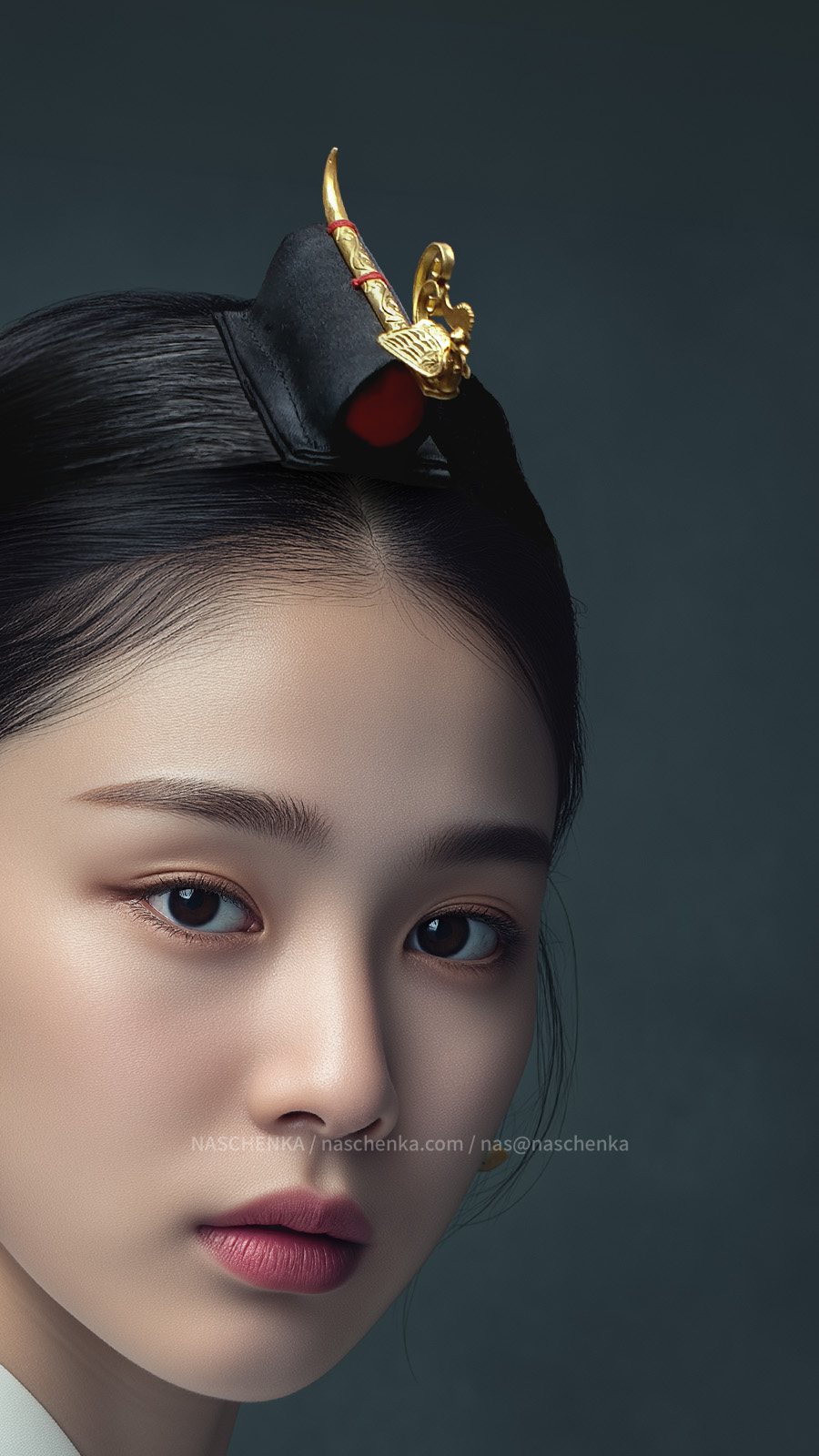
How the parts work together
Because the base is tied into the hair and the hairpieces run back into the chignon, the cheopji is anchored from three directions. That is why it could hold a jokduri or a hwagwan steady during long ceremonies.
Modern construction
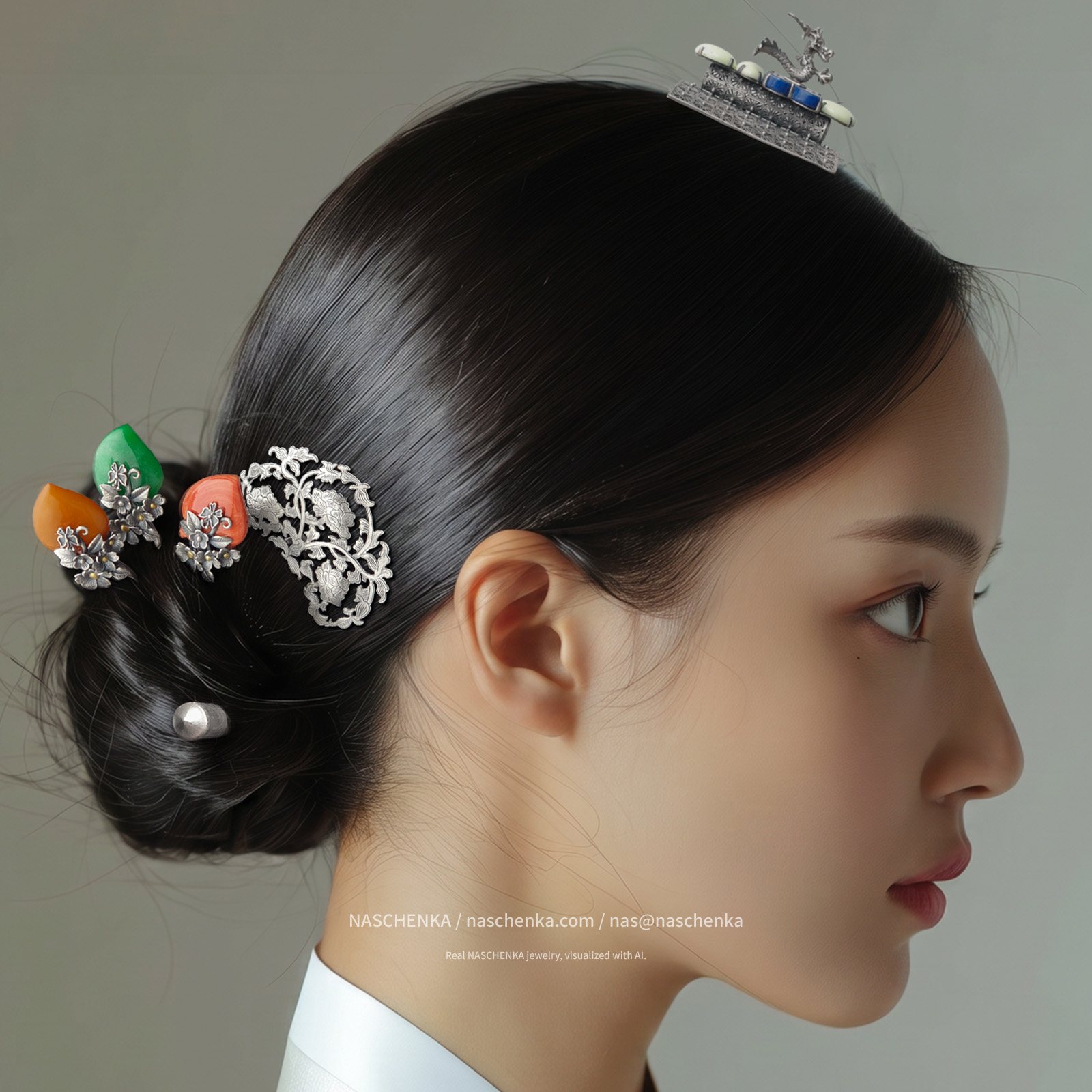
Today's cheopji are usually made as one piece: the ornament is set on a metal plate — often openwork or filigree silver — with a fitting underneath that holds it in the hair. The court proportions remain: a low, horizontal ornament on the parting, decorated at the front.
References
- Encyclopedia of Korean Culture (한국민족문화대백과사전), “첩지,” written by Son Gyeong-ja, Academy of Korean Studies. encykorea.aks.ac.kr
- National Research Foundation of Korea, Dictionary of Korean Costume (한국복식사전), “첩지,” via Academy of Korean Studies Digital Humanities. dh.aks.ac.kr
- Academy of Korean Studies Digital Humanities, “첩지 (貼只),” citing Kang Sun-je et al., Hanguk boksik sajeon (Minsogwon, 2015), p. 691. dh.aks.ac.kr
- National Palace Museum of Korea, “Phoenix cheopji of the Consort of Imperial Prince Yeong (영친왕비 봉첩지),” via Google Arts & Culture. artsandculture.google.com
- Sookmyung Women's University Museum, “Cheopji Hair Style” (replica), via Google Arts & Culture. artsandculture.google.com
- Yu Hui-gyeong, Hanguk boksiksa yeongu (한국복식사연구), Ewha Womans University Press, 1975.