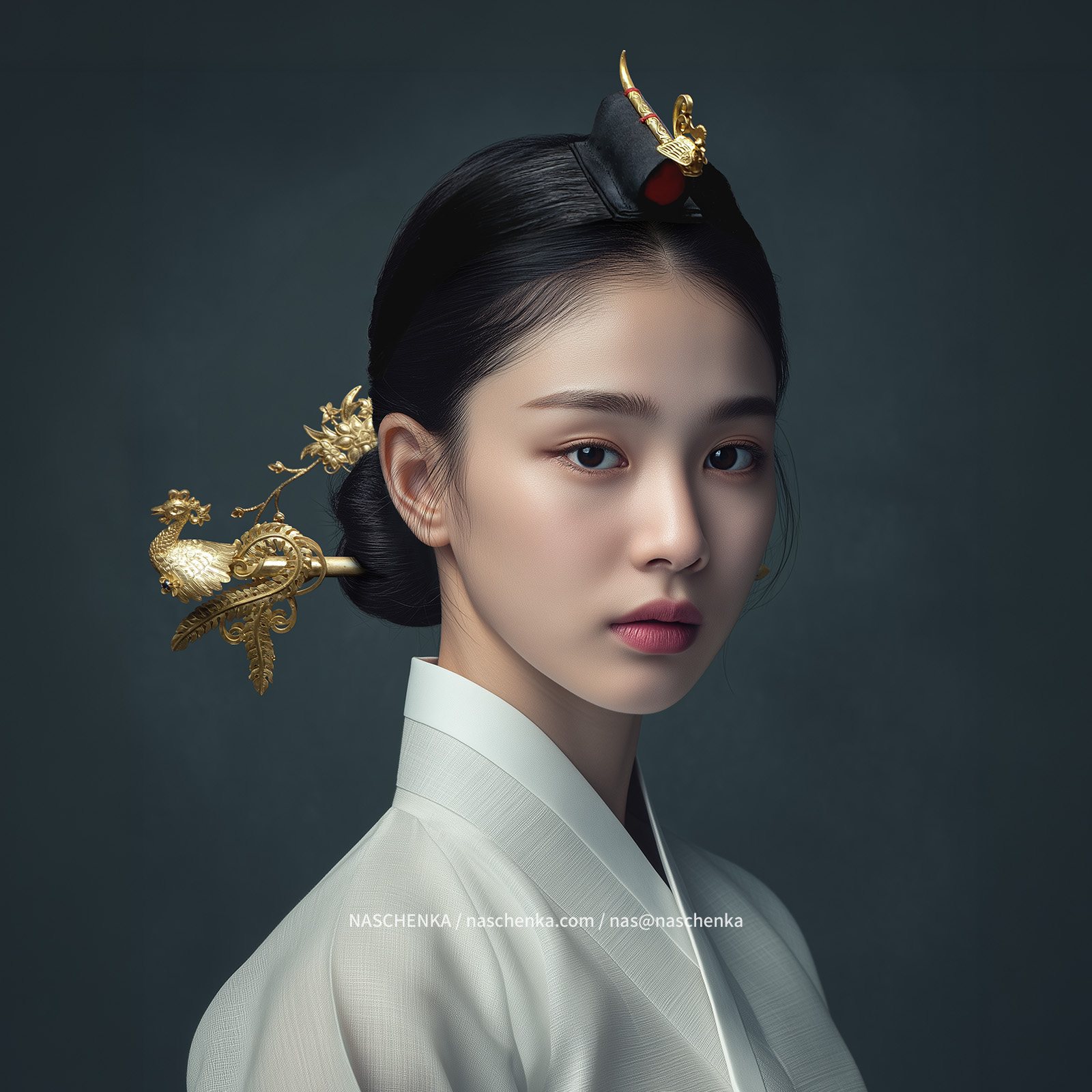
The cheopji is young by the standards of Korean jewelry. The binyeo is thousands of years old; the cheopji belongs to the last two centuries of Joseon. It was born from a change in women's hair, and it ended with the court that wore it.
Before: the age of the gache
For much of Joseon, a formal hairstyle meant the gache, a great wig of added hair built up on the head. Gache grew larger and heavier through the eighteenth century and became ruinously expensive — a matter of status and of debt. The court came to see it as a waste.
The reform of Yeongjo and Jeongjo
King Yeongjo banned the gache in 1756. The ban did not hold, and King Jeongjo issued a stricter code in 1788. Women were to wear their own hair gathered into a jjok, a low chignon, and to use a jokduri or a hwagwan in place of the wig for formal occasions. This is the reform the sources call the baljae gaehyeok (발제개혁, 髮制改革).
A new ornament for a new hairstyle
The Dictionary of Korean Costume traces the cheopji to this reform. The new hairstyle needed two things the wig had once provided: a place to show rank, and a way to hold a crown. The cheopji did both. Set on the parting, it decorated the front of the head; tied in with its hairpieces, it gave the jokduri and hwagwan something to rest against so they would not slide.
Rank at court
Inside the palace the cheopji became part of everyday dress. Its head was graded: the phoenix for the queen and the crown princess, the frog for the titled women of the inner and outer court and for the court ladies, in gilt or in black horn according to rank. Senior court ladies, the sanggung, wore the frog. The hairstyle built around it took its name: cheopji-meori.
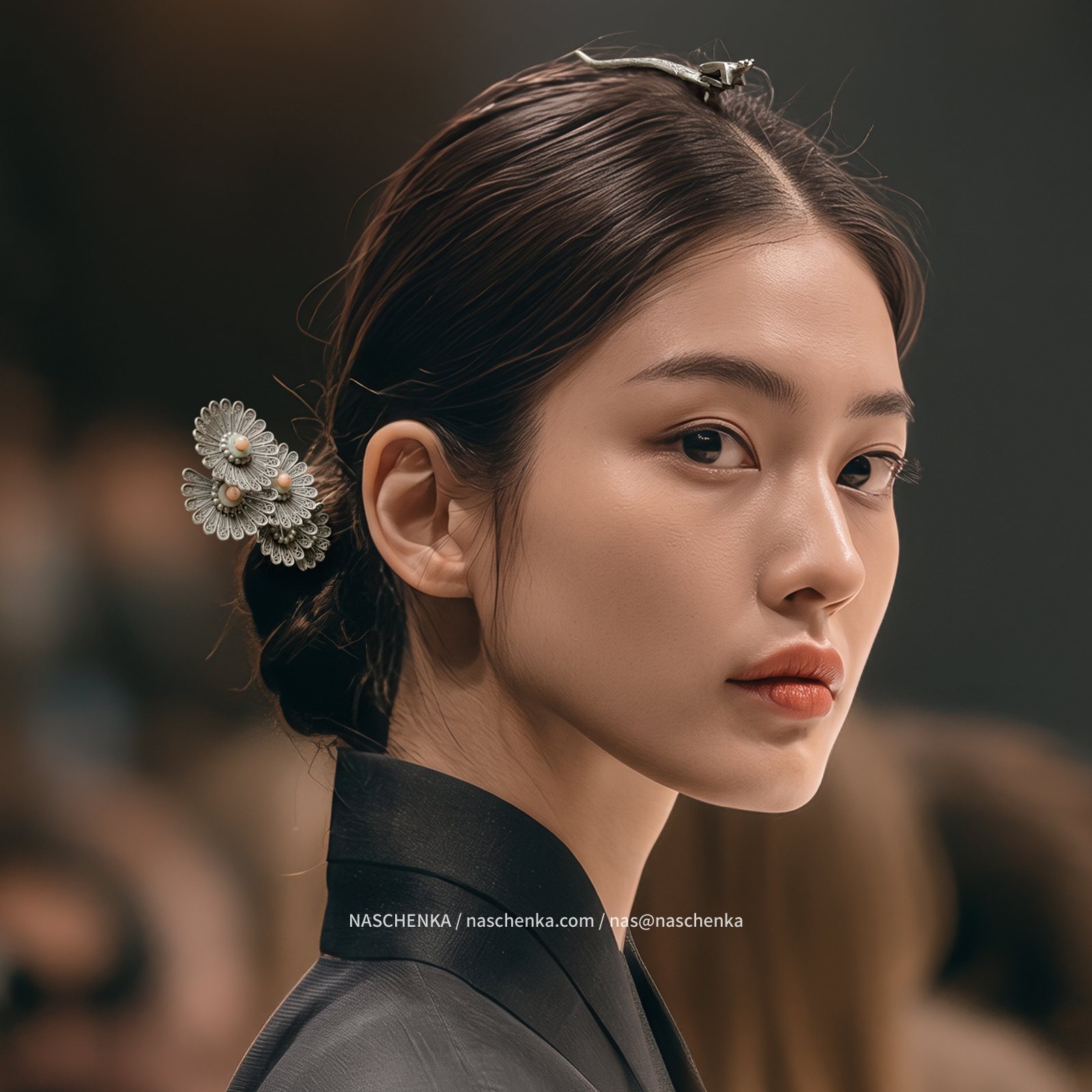
The dragon of the Korean Empire
In 1897 Joseon became the Korean Empire, and the queen became an empress. The gilt dragon cheopji — the highest form in every source — is the empress's ornament. Pieces belonging to the last royal women, among them the Consort of Imperial Prince Yeong, survive in the National Palace Museum of Korea.
Before 1756 Formal hair built on the gache wig.
1756 King Yeongjo bans the gache.
1788 King Jeongjo issues a stricter code; the jjok with jokduri or hwagwan becomes formal hair.
Late Joseon The cheopji is worn daily at court and with ceremonial dress outside it; rank is shown by phoenix and frog, gilt and black horn.
1897–1910 The Korean Empire; the gilt dragon cheopji is the empress's.
20th century The court ends; the cheopji survives in museums, weddings and dance.
Today Historical dramas, ceremonial hanbok and modern jewelry.
After the court
When the court ended, the cheopji lost its daily purpose. It survived where ceremony survived: in museum collections, in traditional weddings and dance, and, from the late twentieth century, in historical dramas, which made it familiar to a new audience around the world. The cheopji today →
References
- Encyclopedia of Korean Culture (한국민족문화대백과사전), “첩지,” written by Son Gyeong-ja, Academy of Korean Studies. encykorea.aks.ac.kr
- National Research Foundation of Korea, Dictionary of Korean Costume (한국복식사전), “첩지,” via Academy of Korean Studies Digital Humanities. dh.aks.ac.kr
- Academy of Korean Studies Digital Humanities, “첩지 (貼只),” citing Kang Sun-je et al., Hanguk boksik sajeon (Minsogwon, 2015), p. 691. dh.aks.ac.kr
- National Palace Museum of Korea, “Phoenix cheopji of the Consort of Imperial Prince Yeong (영친왕비 봉첩지),” via Google Arts & Culture. artsandculture.google.com
- Sookmyung Women's University Museum, “Cheopji Hair Style” (replica), via Google Arts & Culture. artsandculture.google.com
- Yu Hui-gyeong, Hanguk boksiksa yeongu (한국복식사연구), Ewha Womans University Press, 1975.